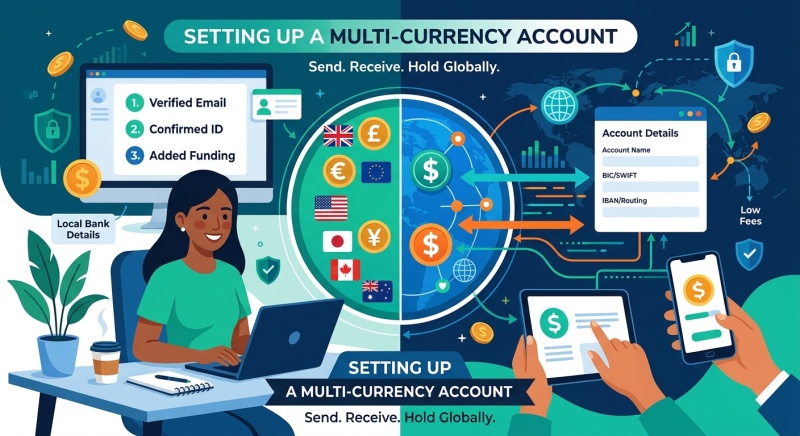

Setting up a multi currency account feels like one of those grown-up finance moves. It’s the moment you finally crossed into the land of people who “optimize” things. Maybe you get paid in USD but live in Europe. Perhaps you travel a lot, sell stuff online with customers paying in different currencies, or simply tired of watching your bank silently shave money off every conversion.
All fair reasons.
But the setup part. That’s where people mess it up.
Not because they are careless, usually. More because multi currency accounts look simple on the surface. Open account. Add currencies. Get paid. Done. Except the fees are hidden, the limits are weird, the compliance steps are annoying, and the small details you ignore in week one become painful later when real money starts moving.
So this is a practical “what not to do” guide. The common mistakes, the expensive ones, the ones that waste time, and a few that can get your account restricted right when you need it most.
First, a quick reality check on what “multi currency account” even means
A lot of providers use the same words, but they are not offering the same thing.
A multi currency account could mean:
- One account that holds multiple currency balances, with local bank details for some of them (like USD ACH details, GBP sort code, EUR IBAN).
- A wallet that holds currencies but does not give you local receiving details.
- A bank account that supports foreign currency sub accounts, but charges for everything.
- A fintech account that looks like a bank but is technically e-money or a payment institution.
None of these are “bad”. You just need to know what you are signing up for. Most mistakes come from assuming it works like a normal bank account in every country and for every currency.
As we navigate through these complexities, it’s also important to consider how the future of money and finance might unfold with advancements in technology and changes in consumer behavior. This understanding can provide valuable insights as you set up and manage your multi-currency account effectively.
1. Choosing a provider before you map your actual use case
This is the most common one. People pick the popular app their friend uses. Or the one with the nicest interface. Or the one that says “hold 40+ currencies”.
Then later they realize they needed something very specific, like:
- Receiving USD from US clients via ACH, not wire
- Paying suppliers in CNY or HKD with local transfer rails
- Getting paid from Amazon marketplaces that require local account details
- High monthly volume where FX spread matters more than subscription price
- A business account with proper statements and multi user access
- A personal account that won’t ask for business documentation every month
Before you open anything, write down your actual flows. Literally:
- Who pays you, from which country, using what method
- Which currencies you receive most
- Which currencies you spend most
- Average and peak transaction sizes
- Whether you need local account details or just a wallet
- Whether you need cards, and in which regions you will use them
If you do this one step, half the other mistakes disappear.
2. Ignoring the difference between FX rate and FX cost
A lot of platforms advertise “real exchange rates” or “mid market rates”. Cool. Then you exchange and still lose money.
Why? Because the cost is not only the rate. It can be:
- Spread baked into the rate you see
- A separate conversion fee
- A markup outside market hours
- Fees on deposits or withdrawals that force extra conversions
- Fees when you pay by card in a currency you don’t hold
And here’s the annoying part. You can have a great FX rate and still a high total cost if fees are applied at the wrong points.
What to do instead:
- Look up the provider’s fee page and read the section for your exact transfer type (local, international, SWIFT, ACH, card, ATM).
- Test with small amounts first and compare the final received amount, not the quoted rate.
- If you will convert often, calculate an estimated monthly cost using your expected volume. Even rough math helps.
3. Setting it up under the wrong profile (personal vs business)
People do this because it is faster. Open a personal account, start receiving payments from clients, and think it’s fine.
Then one day you get asked for documentation. Proof of business activity. Invoices. Contracts. Company registration. Tax ID. Sometimes all at once.
If you are actually using it for business, open a business account. Yes it is more paperwork. But it is the correct paperwork. And it reduces the chance of transfers being flagged later.
Also, business accounts often include features you will eventually want:
- Multi user access and permissions
- Better statements for accounting
- Batch payments
- Integration with accounting tools
- Clear separation for tax purposes
Even if you are a freelancer or solo operator, separating personal and business money saves headaches later. And not just for compliance. For your own sanity when reconciling transactions.
4. Skipping the “receiving details” checklist for each currency
People assume that if they “add USD” they can receive USD like a US bank account. Not always.
Some providers give you:
- USD account details that only accept wire transfers, not ACH
- EUR IBAN that is fine for SEPA but not for SWIFT payments
- Local GBP details that work for UK transfers but not international payments
- Routing details that are “for incoming payments only” and reject some sources
Common trap: you give a client your USD details, they pay from a platform that sends from a third party processor, and the payment gets rejected. Or delayed. Or returned with fees.
Before you share account details with anyone, confirm:
- Which payment networks are supported (ACH, wire, SEPA, SWIFT, Faster Payments)
- Whether third party payments are accepted (some reject them)
- Whether the account can receive from your own name only
- Any reference requirements (invoice number, name matching, etc.)
This sounds tedious, but it is less tedious than explaining to a client why their payment bounced.
5. Not understanding SWIFT fees and intermediary bank charges
If you deal with international wires, SWIFT is where “surprise fees” live.
You might send $5,000 and the recipient receives $4,940. Nobody can clearly explain why. It’s usually a mix of:
- Sender bank fee
- Recipient bank fee
- Intermediary banks taking a cut
- Fee type selection (OUR, SHA, BEN)
If your provider allows you to choose who pays fees, learn what those options mean. In many cases you can’t fully control it, but you can reduce surprises.
Practical tips:
- For large payments, ask the recipient what they prefer and which details reduce intermediaries (sometimes a correspondent bank detail matters).
- Use local rails when possible (ACH for USD, SEPA for EUR, Faster Payments for GBP).
- If you must use SWIFT regularly, track the typical fee loss and price it into your contracts or invoices.
6. Holding too many currencies “just because you can”
A multi currency account makes it easy to collect currencies like Pokémon. USD balance. EUR balance. GBP balance. JPY balance. A tiny amount of CAD you forgot about. It looks harmless.
But this becomes a problem when:
- You lose track of what you have where
- You create accounting clutter
- You leave money idle in currencies you don’t spend
- You start converting at random times without a plan
- Your risk exposure increases (currency fluctuations are real)
A cleaner approach:
- Hold the currencies you actually use.
- Keep a base currency for reporting and budgeting.
- Convert with intention. Not daily, not impulsively. Based on your cash flow needs.
If you are a business, your accountant will thank you. If you are a person, future you will thank you too.
7. Forgetting that “local account” does not always mean “local protection”
This one is subtle.
Some fintech providers give you local bank details, but the underlying structure can be:
- Pooled accounts
- Pass through accounts
- E money safeguarding instead of deposit insurance
- Partner banks holding funds in different jurisdictions
Again, not automatically bad. But it matters if you care about deposit protection, insolvency risk, dispute resolution, and where your money legally sits.
Do a basic check:
- Is this a regulated bank, or an e money institution, or a payments company?
- In which country is it regulated?
- Do you have deposit insurance (and under what scheme), or safeguarding?
- Who is the actual account holder at the bank level, you or the provider?
If you are storing large balances long term, these details are not “fine print”. They are the main text.
8. Not planning for tax and reporting from day one
Multi currency accounts make it easy to earn globally. They also make it easy to accidentally create a tax mess.
A few examples that trip people up:
- Receiving foreign income without tracking invoice dates and exchange rates
- Capital gains or losses from currency conversions (depends on your country, sometimes it matters)
- Business VAT or GST obligations triggered by where customers are
- Mixing personal spending with business income in the same account
- Not keeping proper statements that show the original currency amounts
Do not wait until tax season.
At minimum:
- Keep invoices and match them to incoming payments.
- Save monthly statements.
- Track conversions, especially if you convert large amounts.
- Use accounting software or at least a spreadsheet that records original currency, converted currency, date, and rate.
And yes, talk to a tax professional if you are doing serious volume or operating across borders. This is one of those “pay now or pay way more later” situations.
9. Assuming your card will always spend from the “right” currency balance
Multi currency debit cards are convenient. You hold USD, pay in USD. Hold EUR, pay in EUR. Simple.
Except sometimes:
- The card chooses a different balance than you expected
- The merchant processes in a different currency (dynamic currency conversion)
- The provider auto converts using their own rules
- Offline transactions settle later at a different rate
- Some providers only let you choose a “primary” currency
Two common mistakes here:
Falling for dynamic currency conversion
You are abroad, the terminal asks “Pay in your home currency or local currency?” It feels safer to pick home currency. It is usually worse.
Generally, choose local currency and let your card provider handle conversion. DCC often includes a nasty markup.
Not keeping the needed currency funded
If you plan to spend in EUR next week, make sure your EUR balance is actually funded, or you know exactly what happens if it is not.
Test this with a small transaction before a big trip or a big purchase. Seriously. It saves embarrassment.
10. Not checking transfer limits, velocity limits, and “soft” restrictions
Some platforms have limits that are not obvious until you hit them:
- Daily or monthly transfer caps
- Limits based on verification level
- Limits that change after “risk review”
- Additional checks for new payees
- Delays for first time large transfers
- Limits on cash withdrawals or card spending
If you are planning to route a salary, sell a business, receive a large invoice, or move savings, you must know the limits ahead of time.
What to do:
- Read limits for your region and account type.
- Verify your identity and business early, before you need to move money fast.
- Warm up the account gradually. Small deposits and transfers first. Build history.
I know it sounds silly, like you are training the account. But that is basically what you are doing.
11. Poor naming and organization (it matters more than you think)
This seems too basic, but it is a real issue, especially for businesses.
People open multiple currency balances and then:
- Don’t label what each one is for
- Mix client payments with personal transfers
- Forget what a random incoming payment was tied to
- Struggle during bookkeeping
If your provider allows it, add notes, references, and labels. If not, keep your own tracking doc.
A simple system works:
- One balance per major currency you use
- Consistent payment references (invoice number, customer name)
- A monthly reconciliation habit, even if it is just 30 minutes
The goal is to avoid “mystery money”.
12. Not testing the full loop before going all in
People test receiving money. Or they test sending money. But not the full loop.
You want to test:
- Receive money in currency A from the expected source (client, marketplace, employer).
- Convert currency A to currency B.
- Withdraw currency B to your local bank.
- Spend using the card in both currencies.
- Download statements and confirm they show what you need.
Do this with small amounts first.
Because when something breaks, it usually breaks at the edges. The first ACH deposit. The first SWIFT transfer. The first large conversion. The first withdrawal to a bank with strict name matching.
Better to learn those problems when it is $50, not $50,000.
13. Assuming you can use it in any country, forever
A provider might accept customers from your country today and pause new signups tomorrow. Or they might support residents of a country but not travelers using it there. Or they might restrict features for certain regions.
Also, your own life changes. You move. You change residency. You open a company in another place. You start working with higher risk industries. All of that can trigger new reviews.
Two things help:
- Choose providers with stable regulatory footing in your region.
- Keep a backup option. Another account, another bank, something.
Nobody likes redundancy until they need it.
14. Not reading the compliance triggers that freeze accounts
Account freezes are rare for most people, but when they happen, they are brutal. Multi currency accounts are heavily monitored because cross border flows are higher risk.
Common triggers:
- Receiving large payments with vague references like “payment” or “thanks”
- Sudden spikes in volume
- Lots of inbound payments from unrelated names
- Crypto related transfers (depending on provider policy)
- Funds from high risk countries or industries
- Mismatch between account profile and activity (personal account acting like a business)
- Missing documents when requested
What reduces risk:
- Use clear payment references and invoices.
- Keep documentation ready for large transfers.
- Avoid using the account as a pass through for other people’s money.
- If you are doing anything unusual, ask the provider first or read their policy pages.
It is boring. But boring is good here.
15. Over focusing on “no fees” and under focusing on support quality
“No fees” is a marketing phrase, not a life philosophy.
If the provider has slow support, you will pay in time and stress instead. And when money is in limbo, time and stress are expensive.
Before you commit:
- Search for recent reviews specifically about support and disputes.
- Test support with a basic question and see how they respond.
- Check if they offer phone support, chat, email, and what hours.
If you are running a business, support quality is not optional. It is part of your financial infrastructure.
A simple setup checklist that prevents most mistakes
If you want something practical to follow, here is a clean order of operations:
- Define your top 2 to 3 currencies and your main flows (receive, convert, spend, withdraw).
- Choose a provider that supports the receiving rails you need (ACH, SEPA, etc).
- Open the correct account type (business or personal).
- Complete verification fully, early.
- Add only the currencies you will actually use.
- Test the full loop with small amounts.
- Set rules for conversions and keep records.
- Keep a backup account if the account becomes critical to your income.
That’s it. Not glamorous, but it works.
Wrapping up
Multi currency accounts are genuinely useful. When they are set up right, they reduce fees, simplify global payments, and make you feel weirdly in control of your money.
But the setup is where the traps are. Picking the wrong provider, misunderstanding FX costs, assuming receiving details work everywhere, mixing business and personal, ignoring limits, ignoring compliance, not testing the full loop.
Avoid those, and you are already ahead of most people.
If you want, tell me your country, the currencies you receive and spend, and whether this is personal or business. I can point out the specific setup risks for your exact situation before you commit.
A multi currency account can vary by provider. It might be one account holding multiple currency balances with local bank details for some currencies, a wallet holding currencies without local receiving details, a bank account with foreign currency sub accounts but high fees, or a fintech e-money or payment institution account. None are inherently bad, but it’s important to understand what you’re signing up for since they don’t all function like normal bank accounts in every country or currency.
Before choosing a provider, map out your actual use case: who pays you and from where, which currencies you receive and spend most, transaction sizes, whether you need local account details or just a wallet, and if you require cards or multi-user access. Selecting based on these specifics rather than popularity or interface helps avoid costly mistakes later.
Platforms may advertise mid-market or real exchange rates, but total costs include more than just the rate. There can be spreads baked into rates, separate conversion fees, markups outside market hours, deposit or withdrawal fees causing extra conversions, and card payment fees in non-held currencies. Always check fee pages carefully and test small amounts to understand true costs.
If you’re using the account for business purposes like freelancing, it’s best to open a business account despite more paperwork. Business accounts reduce transfer flags by providing correct documentation and offer features like multi-user access, better statements, batch payments, and accounting integrations. Separating personal and business finances also simplifies tax and accounting processes.
Don’t assume adding a currency means you can receive funds like a local bank in that currency. Providers may have limitations such as USD details accepting only wire transfers (not ACH), EUR IBANs suitable for SEPA but not SWIFT payments, GBP details working only for UK transfers, or routing numbers rejecting certain sources. Confirm which payment networks (ACH, wire, SEPA) are supported to avoid rejected or delayed payments.
Read the provider’s fee page thoroughly for each transfer type you’ll use (local transfers, international wires, SWIFT, ACH, card payments). Understand any spreads or conversion fees applied at different points. Test with small transactions to compare final received amounts. Also consider monthly volumes to estimate ongoing costs. Planning ahead helps prevent unexpected expenses and operational hiccups.