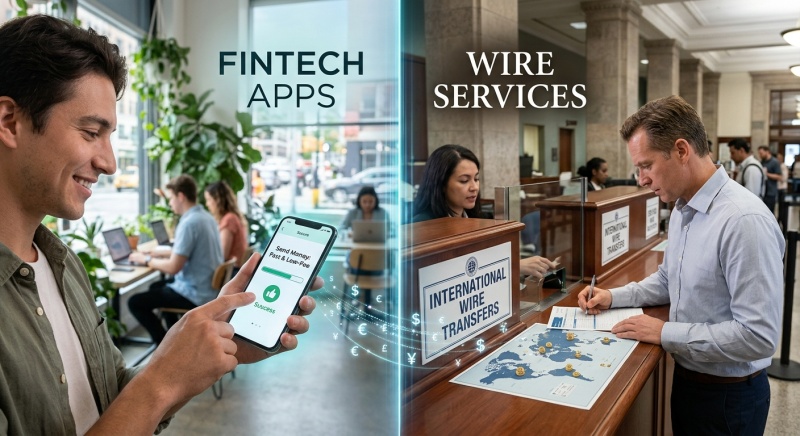

A couple years ago, if someone said, “Just wire it,” you knew what that meant.
Bank branch vibes. Forms. Fees that feel oddly personal. And then that little anxious waiting period where you keep checking like… did it go through, or did I just donate money to the void?
But now in 2026, you’ve got fintech apps that can move money across borders in minutes, show you a live tracker, auto convert currencies, and send the recipient a push notification. It feels like comparing a food delivery app to sending a fax to your favorite restaurant.
So what actually wins in 2026? Fintech apps or wire services?
The annoying but true answer is: it depends on what you’re optimizing for. Speed. cost. certainty. compliance. limits. paper trail. and sometimes just, what the recipient can actually accept.
Let’s sort it out in a practical way.
The quick definitions, so we’re talking about the same thing
Fintech apps
In this context, I mean modern money movement platforms. Some are “neobanks,” some are wallets, some are remittance apps, some are global accounts. The common theme is: app first, low friction, transparent fees, and usually better UX.
They might send money using:
- local bank transfers on both ends (they take your money locally, pay out locally)
- card rails
- ACH equivalents
- internal wallet to wallet transfers
- sometimes even wires underneath, but abstracted away so you don’t deal with the mess
Wire services
This refers to traditional bank wires. Domestic wires, international wires (SWIFT), and the classic bank to bank flow. Usually initiated from a bank portal, a branch, or a business banking setup. You’re using the banking system’s older, more formal pipeline.
Wires are built for finality, traceability, and high value transfers. They are not built for vibes.
What actually changed by 2026?
If you used fintech in 2020 to 2023, you already saw the early shift. But 2026 is where the gap becomes obvious because a few things matured:
- Instant payment rails expanded (in multiple countries). Domestic “instant” became normal, not special.
- Fintech pricing got more transparent because users got wise. The “free transfer” that quietly baked a bad FX rate in? People started noticing.
- Compliance got stricter. Fintech got better at KYC, monitoring, and controls. But also, some transfers get paused more often. You feel it when it happens.
- Businesses adopted fintech tooling instead of treating it like a consumer toy. Payroll, vendor payments, contractor payouts. The serious stuff.
- Banks improved interfaces a bit but not enough. They fixed some online wire forms, added verification steps, improved fraud warnings. Still feels like a tax portal though.
So we’re not debating “are fintech apps real.” They’re real. The debate is whether they fully replace wires. And for 2026, the answer is still no. But they’re winning most everyday scenarios.
For more insight into the payment rails that power these money movements, you can read about payment rails.
The 6 things people actually care about
Let’s compare fintech apps vs wire services on the stuff that matters in real life.
1. Speed: who wins?
Fintech apps win for most transfers under typical limits, especially cross border.
A good fintech app can deliver funds same day, sometimes within minutes, because it’s not literally “wiring” money end to end. It’s often doing a local in and local out model, with liquidity held in various regions.
Wire services win when the recipient’s banking setup is complex or strict, or when you need “bank wire received” as a formal event. But speed is not their strong point, especially internationally.
International wires can be:
- same day if everything is perfect, time zones align, and banks behave
- 1 to 3 business days in normal reality
- longer when an intermediary bank decides to ask questions or hold it for review
And yes, fintech can also get stuck. Usually for compliance reasons. But in terms of raw average speed, fintech is ahead.
2. Cost and fees: who wins?
Fintech apps win in most small and medium transfers, especially when FX is involved.
Wires can hit you with the classic triple fee combo:
- outgoing wire fee (sender bank)
- intermediary bank fees (mysterious, variable)
- receiving bank fee (recipient bank)
Plus, FX spread. Which is often the biggest “fee” and also the least visible.
Fintech usually charges:
- a visible transfer fee, or none
- a visible FX rate with a smaller spread
- sometimes a card funding fee if you’re paying by debit/credit
The key detail in 2026 is that fintech pricing is less sneaky than it used to be. Competition forced that. Still, you have to look at the effective exchange rate. Always.
3. Reliability and certainty: who wins?
This is where it gets interesting.
Wire services win when you need a transfer that is treated as formal, bank grade, and final. When a wire lands, it’s a serious event. There’s a reference number. There’s a trail. It’s not “my app says pending.”
But. Wires can also disappear into a black box for a day or two and you’ll get the least helpful status updates imaginable. Like, “processed.” Great. processed where.
Fintech apps win for user experience and visibility. Tracking is often better. Notifications. clearer timelines. support chat that at least answers.
However, fintech can feel less certain if:
- your account is new
- you’re sending a large amount
- your transfer triggers a compliance review
- the recipient is in a high risk corridor
- you’re sending to a business that requires incoming wires specifically
In fact, fintech apps can also complicate billing and collections, making processes less straightforward in certain scenarios.
So the real answer is: for “I need to know this will land exactly as expected,” wires still have the edge. For “I need visibility and fewer surprises,” fintech often feels more reliable day to day.
4. Limits and high value transfers: who wins?
Wire services win for very large transfers, especially when you’re moving serious sums and want fewer platform limits.
Fintech apps often have:
- daily/weekly limits
- tiered verification
- source of funds documentation requirements
- transfer caps by corridor, recipient type, or payment method
Banks also have compliance. But they’re structurally set up for big money movement. It’s literally one of their core jobs.
So if you’re doing:
- real estate transactions
- large business acquisitions
- large deposits
- high value supplier payments
- escrow like situations
Wires are still the standard.
Fintech can do large transfers too in 2026, some of them do it very well. But you’ll usually need higher verification, more paperwork, and sometimes a conversation.
5. Fraud and safety: who wins?
This is a tie, and also not a tie.
Wires are hard to reverse, which is good when you’re paying the right person, and terrible when you’re not.
Wire fraud is still a huge issue. The most common nightmare: you think you’re wiring your house down payment, but the email was spoofed and you sent it to a scammer. Once it’s gone, good luck.
Fintech apps often have better built in guardrails. Recipient verification prompts. name mismatch warnings. risk checks. step up authentication. sometimes even a delay or confirmation step for first time recipients.
But fintech accounts can also be targets for:
- SIM swap attacks
- credential stuffing
- social engineering
- device compromise
So what wins?
In 2026, fintech tends to feel safer for everyday users because the apps force modern security behaviors. Biometrics. device binding. instant alerts. That stuff helps.
For businesses, wires can be safer if you have strong internal controls, dual approval, and verified vendor onboarding. But a lot of businesses do not, and that’s when wires become risky.
6. Proof, paperwork, and “will the other side accept it?”
This is the boring one that decides everything.
Some recipients, industries, or institutions basically require wires. Period.
Examples:
- certain universities for tuition payments
- escrow accounts
- some landlords or property management firms
- certain B2B vendors
- certain countries or banks that do not support your fintech payout method
- compliance heavy payments where a bank wire receipt is expected
In those cases, fintech can still work if the fintech service can send an actual wire. Some can. Some can’t. Or they can, but only for certain plans or regions.
So, wires win on acceptance in strict environments.
Fintech wins where the recipient is flexible and modern.
Real scenarios in 2026: what I’d use and why
This is the part people actually need. Not theory.
Scenario 1: Paying an international freelancer or contractor
In 2026, fintech wins almost every time.
Why:
- lower FX cost
- faster delivery
- the recipient can often get paid to a local bank account
- you can automate or repeat payments
Wires can still make sense if the contractor insists on it, or if you’re paying a large amount and need formal bank documentation. But most freelancers want the money fast and with fewer fees. Fintech fits that.
Scenario 2: Sending money to family overseas
Again, fintech wins.
This is basically what a lot of fintech apps were born to do. Remittances. The whole point is simple UX, good FX, and reliable delivery. However, government efforts to boost diaspora remittances have had mixed results while the path toward cheaper digital remittances remains uneven.
Wires are overkill unless the recipient only has access to a bank that plays poorly with other payout methods.
Scenario 3: Buying property, paying escrow, closing costs
Wire services win, still.
Not because wires are fun. Because:
- everyone involved expects wires
- the paper trail is standardized
- the amounts are large
- the tolerance for “oops wrong recipient” is zero
- there are procedures around it
Could fintech replace this? Maybe eventually. But in 2026, most real estate workflows still orbit around wires.
Scenario 4: Moving money between your own accounts internationally
This one depends on what you mean by “accounts.”
If you mean you have bank accounts in two countries and you’re trying to move savings, fintech often wins because you can convert currency and transfer with less spread.
If you’re moving very large sums, or you need the funds to land as a wire for documentation reasons, you might still choose wires.
But for the average person doing cross border life stuff, fintech is the default now.
Scenario 5: Business paying international suppliers
This is a toss up.
If the supplier accepts local transfers, fintech can win. It’s cheaper, faster, and you can reconcile more easily if the platform supports invoices and references properly.
But many suppliers, especially in established industries, still prefer wires. They might require SWIFT details. They might want the sender to be a bank.
So wires win on “universally accepted.” Fintech wins on efficiency when it’s accepted.
Scenario 6: Emergency payments where time matters
Fintech usually wins, until it doesn’t.
If it’s a small to medium amount and your account is established, fintech is the move. It can be instant. And the recipient can often get it fast.
But if there’s any chance your transfer triggers a compliance review, you do not want to be finding that out during an emergency. In those cases, a bank wire initiated through a mature business banking setup can actually be more predictable, even if slower.
Yeah, it’s annoying. But predictability is its own kind of speed.
The hidden tradeoffs nobody mentions
A lot of comparisons online are basically “fintech good, banks bad.” That’s lazy.
Here are the real tradeoffs in 2026.
Fintech’s big weakness: account stability and compliance pauses
Fintech platforms are regulated, sure. But their compliance systems can be aggressive, and customer support quality varies wildly.
If your transfer gets flagged, you might deal with:
- document requests
- source of funds checks
- extra waiting time
- vague explanations because they can’t say much
Banks do this too. But fintech can feel more abrupt because the relationship is app based. No branch manager. no personal banker. no phone line that actually resolves it.
If you’re running a business, this matters. A lot.
Wires’ big weakness: opacity and unpredictable total cost
Wires are like shipping a package without tracking, then being told the shipping fee might change because your box “went through an extra warehouse.”
Intermediary banks. lifting fees. recipient fees. sometimes your recipient receives less than you sent, and then you look like the villain.
Also, wire details are easy to mess up. Wrong SWIFT. wrong account format. wrong beneficiary name. And then you’re in correction hell.
So yes, wires are “serious.” They’re also clunky.
So what wins in 2026, overall?
If you forced me to choose one winner for most people in most cases?
Fintech apps win in 2026.
Because for the average transfer, the user experience and total cost are better, and the speed is usually faster. Plus, you get visibility. Tracking. notifications. clearer FX. all the stuff that makes sending money not feel like an administrative punishment.
But I’m not going to pretend wire services are dead.
Wire services still win for:
- very large transfers
- real estate and escrow
- certain B2B supplier payments
- certain compliance heavy situations
- places where the recipient expects a wire and nothing else
So the real “winner” depends on the type of payment.
Fintech is the default tool. Wires are the specialized tool you still need in your kit.
A simple decision checklist (use this and you’ll pick right most of the time)
If you’re staring at your screen wondering which route to use, run through this:
Choose a fintech app if:
- you care about lower total cost, especially FX
- you want speed and a clear ETA
- the amount is small to medium
- the recipient can accept local transfers or wallet payouts
- you want better tracking and simpler setup
- you’re doing repeat payments (contractors, family support)
Choose a wire service if:
- the amount is very large
- you need a formal bank wire receipt for the process
- you’re paying escrow, real estate, legal settlements, certain tuition flows
- the recipient demands SWIFT wire only
- you can’t risk platform limits or app based holds
- you have a business banking process with approvals in place
One more thing, because this is where people get burned
Whatever you choose in 2026, the biggest risk is still human error.
Not the technology. The human.
Double check:
- recipient name spelling
- bank account numbers, IBAN, routing codes, SWIFT
- whether the recipient expects fees to be shared or paid by sender
- whether you are sending in the correct currency
- the first time you pay someone, send a tiny test amount if possible
And for wires, especially for high value stuff: verify instructions using a second channel. Call a known number. Not the email thread. not the “new updated wiring instructions” PDF.
That scam is still everywhere.
Wrap up
In 2026, fintech apps are what most people reach for first. They’re faster, usually cheaper, and the experience is just better. You feel like you’re using a modern system.
Wire services are still the heavyweight option. Less friendly, more formal, more universally accepted in high stakes contexts. And for big transfers, they still carry a certain “this is how it’s done” weight.
So if you’re asking “what wins,” here’s the clean takeaway:
For everyday personal transfers, cross border payments, freelancers, and repeat payouts, fintech wins.
For high value, high formality, and situations where the other side demands it, wires still win.
And honestly, the smartest move in 2026 is not picking a side. It’s knowing which lane you’re in before you hit send.
Fintech apps are modern money movement platforms like neobanks, wallets, remittance apps, or global accounts that prioritize app-first design, low friction, transparent fees, and better user experience. They often use local bank transfers, card rails, ACH equivalents, or internal wallet transfers to move money. In contrast, traditional wire services refer to bank wires initiated through bank portals or branches using older banking systems like SWIFT, designed for high-value transfers with finality and traceability but less user-friendly experience.
By 2026, instant payment rails have expanded globally making domestic instant payments normal. Fintech pricing has become more transparent as users became aware of hidden fees. Compliance measures have tightened leading to better KYC and monitoring but sometimes causing transfer delays. Businesses have adopted fintech tools for serious use cases like payroll and vendor payments. Banks have improved their interfaces slightly but still lag behind fintech in user experience.
Fintech apps generally win on speed for most transfers under typical limits, especially cross-border ones. They can deliver funds within minutes or same day by using local in-and-out models with liquidity held regionally. Wire services can be same day only under perfect conditions but typically take 1 to 3 business days internationally and longer if intermediary banks review the transfer.
Fintech apps usually offer lower costs for small to medium transfers involving foreign exchange by charging visible transfer fees or none at all and providing better FX rates with smaller spreads. Traditional wire services often impose multiple fees including outgoing wire fees, intermediary bank fees, receiving bank fees, plus less visible FX spreads which can add up significantly.
Wire services are preferable when you need a formal, bank-grade transfer that is treated as final and traceable—important for high-value transactions requiring official confirmation of receipt. They also work better if the recipient’s banking setup is complex or only accepts traditional wires. For compliance-heavy scenarios where guaranteed certainty is paramount, wires remain the trusted choice.
Yes, by 2026 fintech apps have matured with stricter compliance controls and are widely adopted by businesses for payroll, vendor payments, and contractor payouts. While some transfers may occasionally be paused due to compliance checks, overall they provide fast, transparent, and user-friendly solutions suitable for everyday business transactions even though wires still dominate where formal finality is required.